Troubleshooting Phosphatase Performance in Complex Matrices
Phosphatase enzymes are often specified for a clear task: remove phosphate groups from a substrate, release inorganic phosphate, shift solubility, alter charge, prepare an analyte, or drive a process endpoint. In real matrices, the task is rarely isolated. Proteins, salts, chelators, detergents, suspended solids, preservatives, fermentation residues, and product phosphate can all change the result.
This guide is written for teams seeing inconsistent conversion, slower-than-expected performance, or unexplained loss during formulation, diagnostics preparation, food processing, wastewater treatment, bioprocessing, or specialty chemical workflows. The goal is not to guess harder. The goal is to separate enzyme health, substrate accessibility, and matrix interference with enough discipline to make a purchasing or process decision.
Start with the failure pattern
Before changing the enzyme, define the behavior. Different failure patterns usually point to different causes.
Performance is low from the first contact
If conversion is poor immediately after dosing, suspect matrix inhibition, unsuitable pH, substrate inaccessibility, or an incorrect enzyme class for the phosphate linkage. Acid phosphatases, alkaline phosphatases, protein phosphatases, nucleotidases, and broad phosphomonoesterases may not behave interchangeably, even when the headline reaction sounds similar.
Performance starts well, then stalls
A clean early phase followed by a plateau often indicates product inhibition, pH drift, phosphate accumulation, cofactor depletion, surface binding, or progressive denaturation. In viscous or particulate systems, the stall may also reflect mass-transfer limits rather than enzyme exhaustion.
Performance varies by lot, batch, or site
Intermittent inconsistency usually points to matrix composition, upstream raw material variation, hold time, preservative changes, cleaning residue, or differences in mixing order. When the enzyme itself is stable in a simple control but variable in the production matrix, the root cause is usually the matrix.
Confirm the chemistry before optimizing conditions
Phosphatase is a functional category, not a single behavior profile. The first diagnostic step is confirming that the enzyme class matches the substrate.
Key questions:
Is the target a phosphate monoester, phosphoprotein, nucleotide, phytate-related phosphate, sugar phosphate, or another organophosphate?
Is the phosphate group exposed, folded into a protein structure, embedded in a particle, or complexed with minerals?
Is full dephosphorylation required, or is partial conversion acceptable?
Does the process need broad specificity or selectivity?
Will the enzyme contact the substrate before or after heat, pH shift, filtration, fermentation, or concentration?
A mismatch at this level cannot be solved reliably with more dosing. It may create higher cost, higher impurity load, and still leave the process underperforming.
Matrix components that commonly suppress phosphatase performance
Complex matrices do not need to destroy phosphatase to reduce apparent conversion. Many interferences are reversible, conditional, or physical.
Free phosphate and phosphate buffers
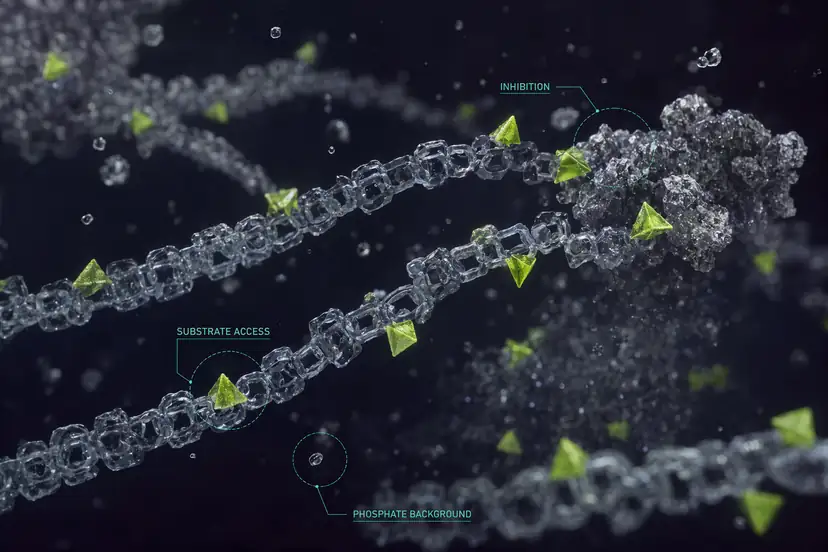
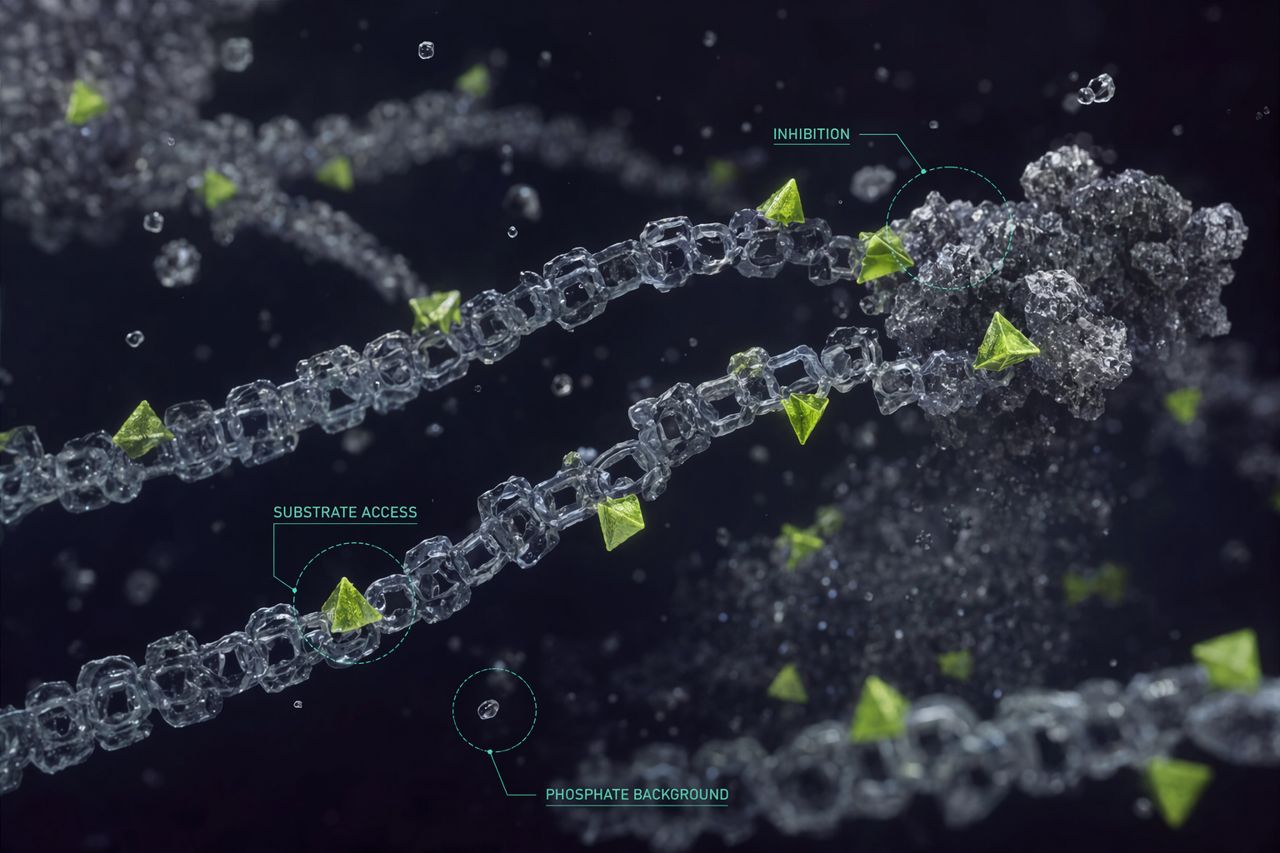
Phosphate already present in the system can reduce the driving force for release or interfere with endpoint interpretation. In some workflows, phosphate buffers are convenient but counterproductive. If the process allows it, compare with a non-phosphate buffering approach during development.
Chelators and metal-binding ingredients
Some phosphatases depend on metal ions for structure or catalysis. Chelators, certain preservatives, and mineral-binding components may reduce performance even when the enzyme remains visually soluble. Review all raw materials, including trace additives and carryover from upstream steps.
Divalent and multivalent ions
Calcium, magnesium, zinc, iron, and other ions can support, inhibit, precipitate, or redirect phosphatase behavior depending on enzyme type and substrate. Mineral-rich food, fermentation, and wastewater matrices deserve special attention because local ion concentration can be very different from the bulk formulation.
Detergents, solvents, and surfactants
Low levels may improve wetting or substrate exposure. Higher or incompatible levels may unfold the enzyme, block substrate contact, or shift partitioning at interfaces. If surfactants are required, evaluate order of addition and pre-dilution rather than only changing total concentration.
Proteases and reactive impurities
In biological and fermentation-derived matrices, proteases can progressively reduce enzyme integrity. Oxidants, reducing agents, aldehydes, and antimicrobial preservatives can also damage sensitive proteins. A time-dependent loss pattern often indicates chemical or proteolytic stress.
Suspended solids and adsorptive surfaces
Phosphatases can bind to particles, filters, membranes, resins, glass, stainless steel conditioning films, or biomass. Bound enzyme may be inactive, partially active, or simply unavailable to the target substrate. In scale-up, increased surface area and different residence time can make this more visible.
Process variables that change the same formulation
A formulation that looks correct on paper can still underperform if the process sequence is unfavorable.
pH profile, not just pH setpoint
Phosphatases are highly pH-sensitive, but the important question is the pH experienced over time. Substrate hydrolysis, phosphate release, raw material buffering, carbon dioxide ingress, and cleaning carryover can shift local pH. Check the pH after blending, after hold, and near the expected endpoint.
Temperature exposure history
Short heat contact, warm holding, cold-thaw cycles, and localized hot spots can create very different outcomes. A phosphatase may tolerate the nominal process temperature but not the cumulative exposure created by slow ramping, recirculation, or contact with heated surfaces.
Mixing order
Adding enzyme directly into concentrated salts, preservatives, organic solvent pockets, or low-water phases can cause avoidable loss. In many systems, performance improves when the enzyme is introduced into a compatible aqueous phase, then blended into the full matrix under controlled shear.
Viscosity and mass transfer
High-solids slurries, protein concentrates, hydrocolloid systems, and biomass streams can make substrate access the limiting factor. If performance improves with dilution or better dispersion, the enzyme may be sound while contact efficiency is poor.
A disciplined troubleshooting sequence
Use a short, structured investigation rather than changing many variables at once.
Run a clean compatibility check. Confirm that the enzyme performs as expected outside the complex matrix under supplier-recommended handling conditions.
Add matrix fractions one at a time. Introduce salts, buffers, preservatives, solids, surfactants, and substrate concentrate separately to identify the suppressive component.
Compare pre-addition and post-addition exposure. Incubate the enzyme with the matrix before substrate contact, then compare against immediate addition. A large difference suggests enzyme damage or binding.
Evaluate order of addition. Change the sequence without changing the recipe. This often reveals incompatibilities hidden in the final blended state.
Track the reaction profile over time. A slow start, fast start with plateau, and delayed collapse each point to different causes.
Check hold-time and storage stress. Test the enzyme after planned thawing, staging, blending, and line hold conditions.
Review endpoint interpretation. Make sure the chosen process readout is not being distorted by background phosphate, turbidity, color, precipitation, or matrix drift.
The best troubleshooting plan produces a decision: adjust the matrix, change the process sequence, select a different phosphatase type, use a stabilized format, or redesign the endpoint.
When to consider a different phosphatase format
Changing conditions is not always enough. A different phosphatase source, purification profile, stabilization system, or physical format may be more appropriate when:
The substrate is structurally shielded or highly specific.
The matrix contains unavoidable inhibitors.
The process includes heat, shear, solvent, or extended hold time.
Background phosphate cannot be reduced.
Downstream purity requirements limit total protein addition.
The enzyme must be immobilized, retained, or removed after use.
Production scale introduces surface adsorption or residence-time problems.
For B2B sourcing, this is where technical fit matters more than a generic catalog label. The right specification should reflect the matrix, target substrate, process window, storage plan, and downstream constraints.
Scale-up failure modes to watch
Phosphatase performance can look stable at bench scale and drift at pilot or production scale. Common causes include:
Longer time between hydration, dosing, and substrate contact.
Different shear environment and air-liquid interface exposure.
Slower thermal equilibration.
Non-uniform pH adjustment.
Greater contact with pumps, hoses, membranes, and tanks.
Raw material lots with different mineral or phosphate background.
Incomplete dispersion in high-solids systems.
Treat scale-up as a new matrix, not merely a larger vessel. Maintain the same order-of-addition logic and confirm that the enzyme experiences the intended environment before the reaction window begins.
Practical information to prepare before requesting support
A focused technical request speeds up qualification and pricing. Useful information includes:
Target substrate and desired conversion outcome.
Matrix type and major components.
Expected pH and temperature profile.
Salts, minerals, chelators, preservatives, solvents, detergents, or proteases present.
Order of addition and planned hold times.
Required physical format: liquid, powder, stabilized blend, or immobilized system.
Downstream limits on residual protein, minerals, color, odor, or insolubles.
Production scale and packaging expectations.
You do not need to disclose proprietary formulations in full. A functional matrix description is often enough to begin screening the right phosphatase direction.
Request pricing or technical fit guidance
If your phosphatase process is stalling, drifting, or behaving differently in the real matrix than in a clean system, send the process context and target outcome. The Phosveil team can help frame the enzyme selection, format requirements, and commercial supply path.