
learn
Phosphatase vs Kinase: Opposite Enzyme Functions Explained
A clear B2B guide to how phosphatase enzymes and kinases differ, where each is used, and what formulation, diagnostics, and bioprocess teams should evaluate.
Request pricing A clear B2B guide to how phosphatase enzymes and kinases differ, where each is used, and what formulation, diagnostics, and bioprocess teams should evaluate.
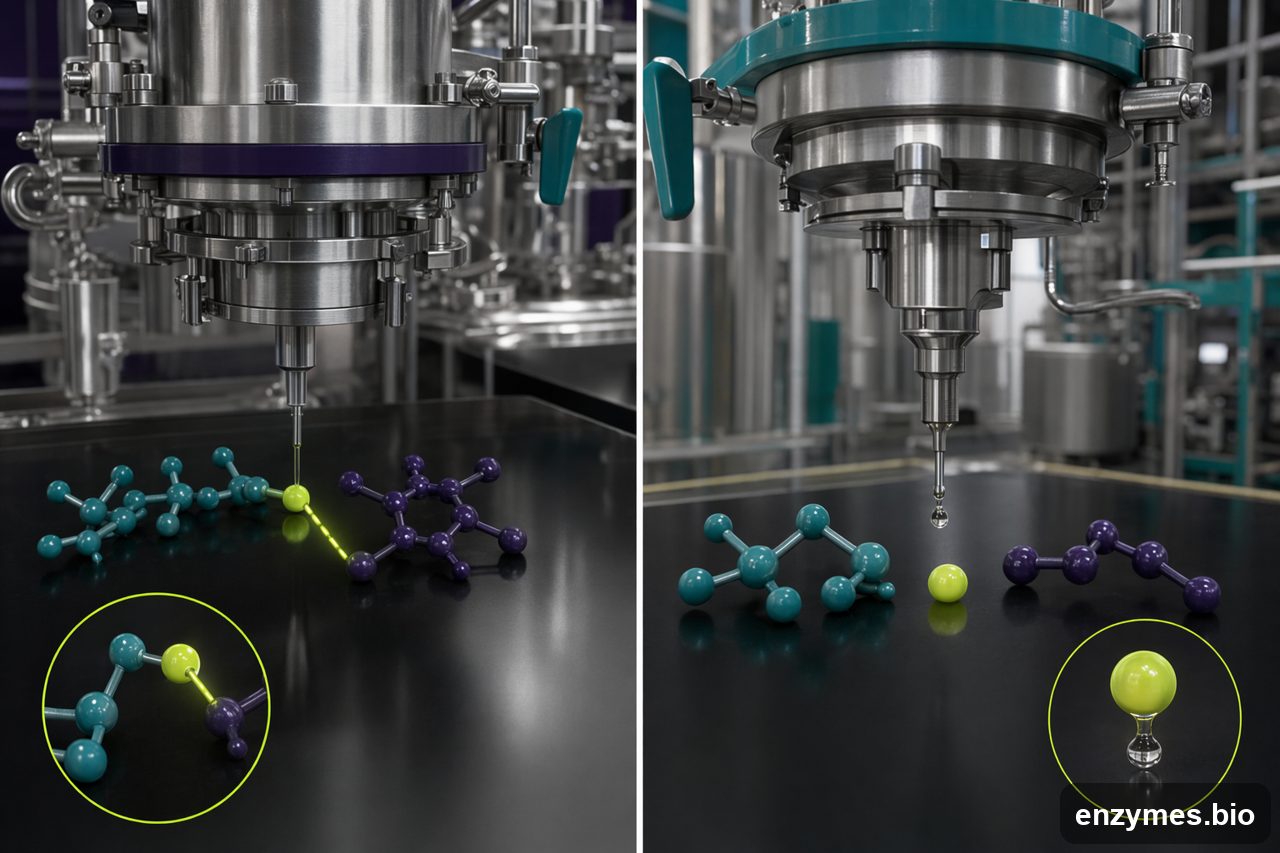
Request pricingPhosphatases and kinases manage the same chemical handle from opposite directions: phosphate. A kinase transfers a phosphate group onto a substrate. A phosphatase removes a phosphate group from a substrate. That difference sounds simple, but it drives major decisions in diagnostics, cell biology, fermentation control, food processing, molecular workflows, and industrial biocatalysis.
For B2B teams, the practical question is not only “which enzyme does what?” It is whether the enzyme function supports the desired signal, conversion, cleanup step, or process endpoint under the real constraints of pH, temperature, matrix chemistry, regulatory expectations, and supply format.

A kinase catalyzes phosphorylation. In biological systems, this commonly means transferring a phosphate group from a donor molecule to a target substrate. Protein kinases regulate signaling networks. Sugar kinases prepare carbohydrates for metabolism. Nucleoside and nucleotide kinases support nucleotide interconversion and molecular biology workflows.
In process or analytical contexts, a kinase may be selected when the goal is to:
The central operating concept is addition: phosphate is installed onto the target.
A phosphatase enzyme catalyzes dephosphorylation. Instead of installing phosphate, it cleaves phosphate from a phosphorylated substrate through hydrolysis. Phosphatase enzymes include alkaline phosphatases, acid phosphatases, protein phosphatases, phytases, nucleotidases, and other specialized dephosphorylating enzymes.
In industrial and analytical settings, phosphatase may be selected when the goal is to:
The central operating concept is removal: phosphate is detached from the target.
| Factor | Phosphatase | Kinase |
|---|---|---|
| Primary function | Removes phosphate | Adds phosphate |
| Reaction type | Dephosphorylation by hydrolysis | Phosphorylation by phosphate transfer |
| Typical substrate state | Already phosphorylated | Unphosphorylated or partially phosphorylated |
| Common donor requirement | Usually water participates in hydrolysis | Often requires ATP, GTP, or another phosphate donor |
| Common business use | Signal generation, cleanup, dephosphorylation, phosphate release | Phosphate labeling, pathway construction, intermediate synthesis |
| Process question | “What do we need to dephosphorylate?” | “What do we need to phosphorylate?” |
The wrong enzyme class can reverse the intended process. If a workflow depends on maintaining a phosphorylated intermediate, phosphatase contamination or carryover can reduce yield or erase signal. If a diagnostic design depends on dephosphorylation to release a detectable product, kinase activity is not a substitute; it serves a different direction of chemistry.
For formulation scientists and process engineers, the key variables include:
In cell signaling, phosphorylation is a reversible control mechanism. Kinases attach phosphate groups to alter protein conformation, binding behavior, localization, or catalytic state. Phosphatases remove those groups to reset or redirect the signal.
A common oversimplification is that kinases activate and phosphatases deactivate. Sometimes that is true. In other pathways, phosphorylation inhibits a protein, and phosphatase action restores activity. The effect depends on the substrate and phosphorylation site.
For research, screening, and assay development teams, this means enzyme selection must follow the biological model. The question is not which enzyme is “stronger.” The question is which direction of phosphate chemistry produces the required state.
Phosphatase enzymes are widely used in detection workflows because dephosphorylation can release a measurable product from a designed substrate. Alkaline phosphatase, for example, is used in immunoassay and molecular detection architectures where enzyme-linked signal amplification is required.
Typical design considerations include:
Phosphatase selection is rarely isolated from the full kit architecture. Blocking agents, preservatives, detergents, salts, and detection substrates can all change performance.
In food and feed applications, phosphatase-related chemistry often centers on phosphate release, mineral availability, substrate modification, or process verification. Phytase, a specialized phosphatase, hydrolyzes phytate and is used where bound phosphorus and mineral interactions matter.
In industrial biotech, phosphatases may support:
The best candidate depends on the substrate class and matrix. A phosphatase suitable for a clean laboratory buffer may not perform the same way in a high-solids process stream, complex lysate, or food-grade formulation.
Choose phosphatase when the process objective is to:
Choose kinase when the process objective is to:
Before requesting pricing, define the process target clearly. The most useful technical brief includes:
This information helps narrow the enzyme class, grade, and formulation pathway without exposing proprietary assay details.
Phosphatases and kinases are opposite in reaction direction, but they are not interchangeable components. They differ in substrate recognition, mechanism, cofactor behavior, formulation stability, inhibition profile, and downstream impact. A kinase system may require a phosphate donor and generate phosphorylated products. A phosphatase system may be sensitive to phosphate concentration, chelation, or competing phosphorylated compounds.
In manufacturing or diagnostics, the difference can affect raw material specification, process control strategy, validation plan, and cost of goods.
Phosphatases remove phosphate. Kinases add phosphate. Together, they define a reversible chemical axis that biology uses for control and industry uses for conversion, signal generation, and process design.
For teams evaluating phosphatase enzymes, the most important step is to map the substrate, matrix, and desired endpoint before selecting a grade or formulation. Directionality comes first. Optimization follows.
If your project requires phosphatase for diagnostics, food and feed processing, industrial biotech, molecular workflows, or custom formulation work, send the core process details and our team will help align the enzyme format with the application.


Tell us your application and volume — we reply with pricing and lead time.