learn
Phosphatase Stability, Handling, and Storage Considerations
Operational guidance for handling, storing, shipping, and formulating phosphatase enzymes across industrial, diagnostics, food, and biotech workflows.
Request pricing Operational guidance for handling, storing, shipping, and formulating phosphatase enzymes across industrial, diagnostics, food, and biotech workflows.
Request pricingPhosphatase performance is shaped as much by handling discipline as by enzyme selection. For formulation scientists, diagnostics teams, process engineers, food technologists, and industrial biotech buyers, the practical question is not simply whether a phosphatase is active. It is whether the enzyme remains predictable through procurement, shipping, storage, reconstitution, batching, and use.
This guide outlines the stability variables that should be reviewed before specifying, qualifying, or scaling a phosphatase-containing workflow. It is intentionally operational: no manufacturer-specific release criteria, no assay protocols, and no confidential activity-unit framing.
Phosphatase enzymes catalyze the removal of phosphate groups from substrates. That broad function covers multiple enzyme families, including alkaline phosphatases, acid phosphatases, protein phosphatases, phytase-adjacent workflows, and specialized dephosphorylation tools used in diagnostics and biotechnology.
Because these enzymes differ in structure and cofactor sensitivity, a storage condition that works for one phosphatase format may be inappropriate for another. Stability planning should account for:
Elevated temperature can accelerate unfolding, aggregation, and loss of functional conformation. Short excursions may be acceptable in some supply chains, but they should be treated as controlled deviations, not assumptions.
For B2B procurement, define expected shipping exposure, warehouse conditions, in-process hold points, and post-opening use windows. If the enzyme will be dosed into a warm process stream, distinguish between storage stability and short-contact process tolerance.
Repeated freeze-thaw cycles can concentrate salts, shift pH locally, promote aggregation, and alter container interaction. Liquid phosphatase products are often best managed through aliquoting, controlled thawing, and avoiding partial refreezing after routine use.
If frozen storage is part of the plan, document how many handling events are expected between receiving and final use. Scale-up often fails at this point: a bench vial is thawed once, while a production container may be opened, sampled, moved, and reconditioned multiple times.
Phosphatases are typically sensitive to pH because ionization states influence substrate binding and catalytic residues. Storage buffers and process buffers should be reviewed separately.
A common issue is phosphate-containing buffer. In some workflows, phosphate is harmless. In others, it can interfere with downstream measurement, product specifications, or process interpretation. Alternative buffering systems may be preferred when free phosphate is a concern.
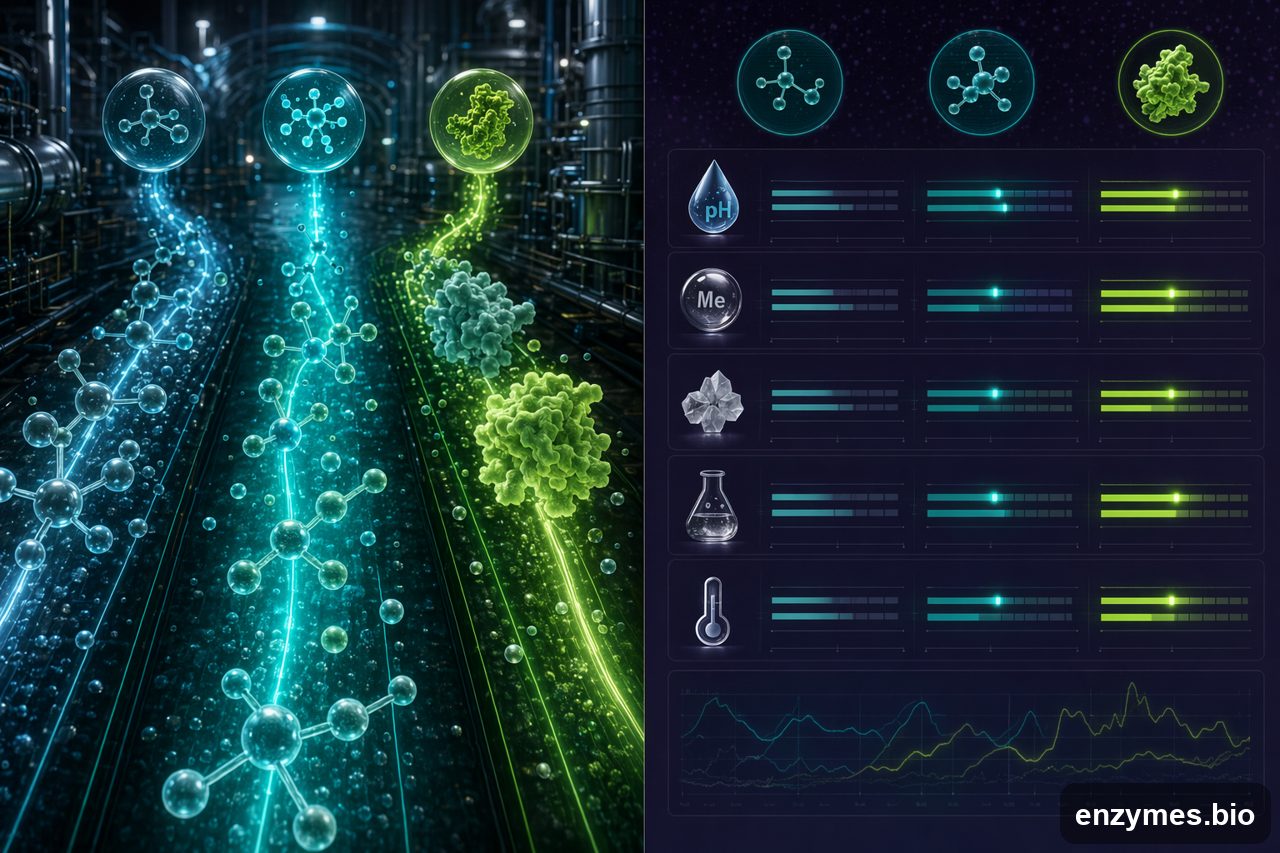
Some phosphatases depend on metal ions for structure or catalysis. Chelators can reduce performance if they remove required metals. Conversely, uncontrolled trace metals may create side reactions, precipitation, or matrix effects.
When qualifying a phosphatase, review whether the enzyme is metal-dependent, metal-sensitive, or compatible with chelating agents present in the formulation, sample matrix, or cleaning regime.
Protein enzymes can be degraded by proteases from raw materials, biological matrices, or contaminated process fluids. Microbial growth can also alter pH, consume stabilizers, generate proteases, or compromise regulated applications.
For diagnostic and food-related use, the handling plan should address hygienic transfer, preservative compatibility where permitted, container closure integrity, and microbial control appropriate to the use case.
Low-concentration enzymes can adsorb to tubing, filters, membranes, mixing vessels, and container walls. Agitation and foaming increase air-liquid interface exposure, which may accelerate denaturation.
Review contact materials early, especially for automated diagnostic systems, recirculating process loops, membrane operations, and small-volume dispensing formats.
| Format | Typical operational focus | Key buyer questions |
|---|---|---|
| Liquid concentrate | Cold-chain discipline, microbial control, freeze-thaw management, container compatibility | How will the product be sampled, diluted, and held after opening? |
| Frozen liquid | Thaw procedure, aliquoting, refreeze avoidance, temperature excursion tracking | How many thaw events are realistic in production? |
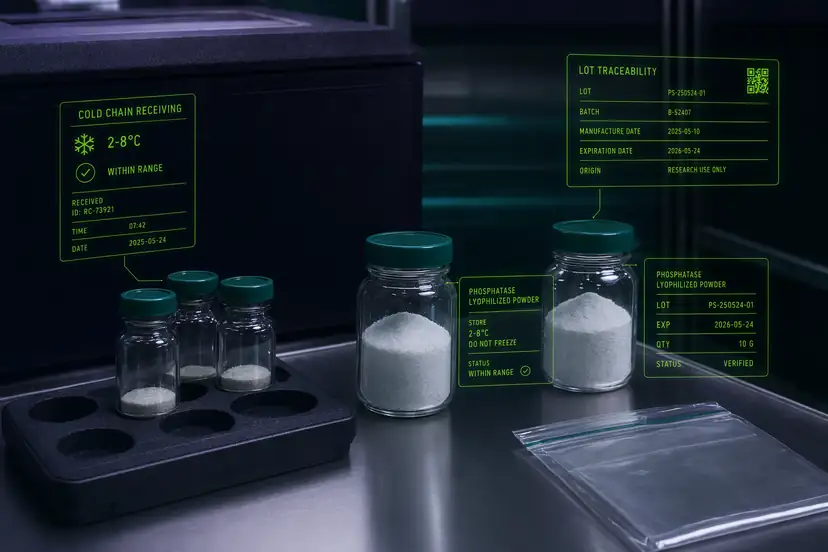
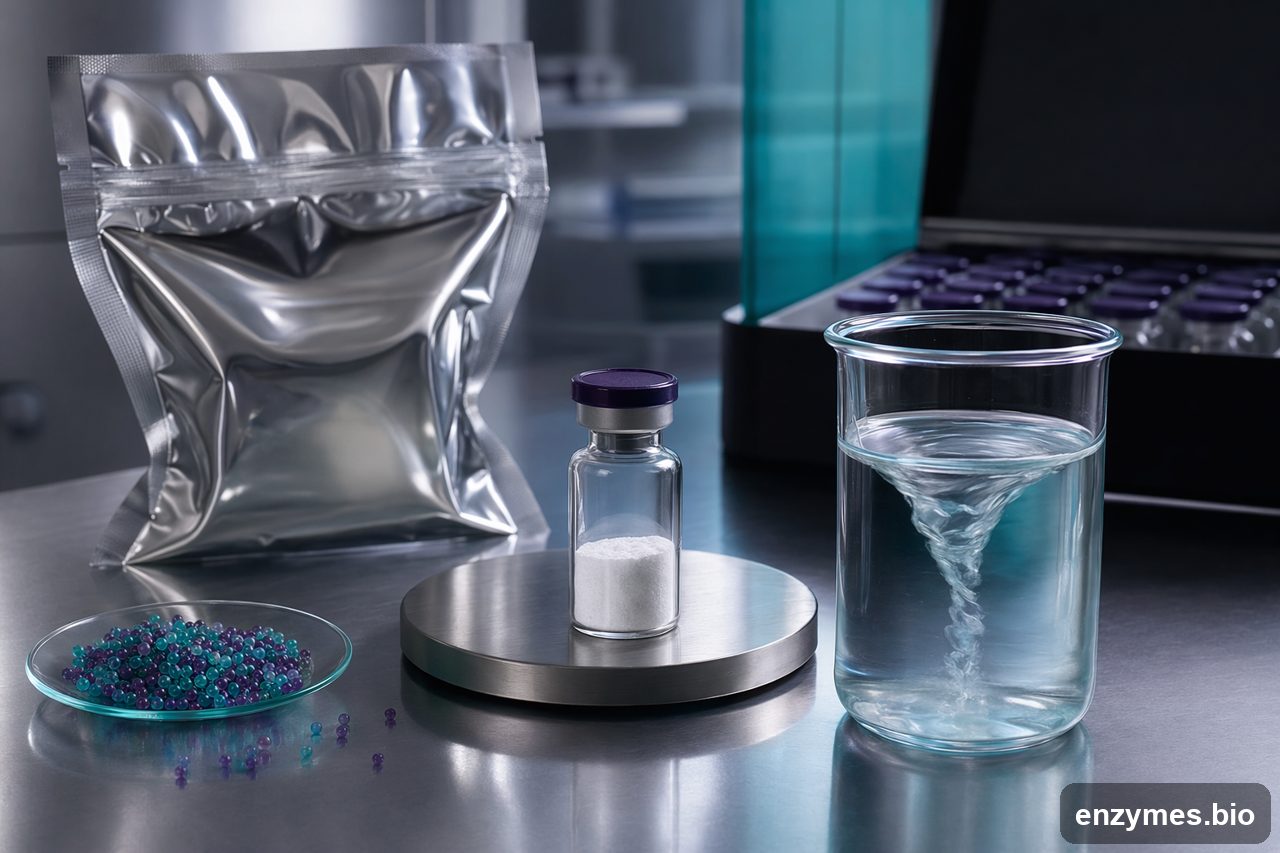
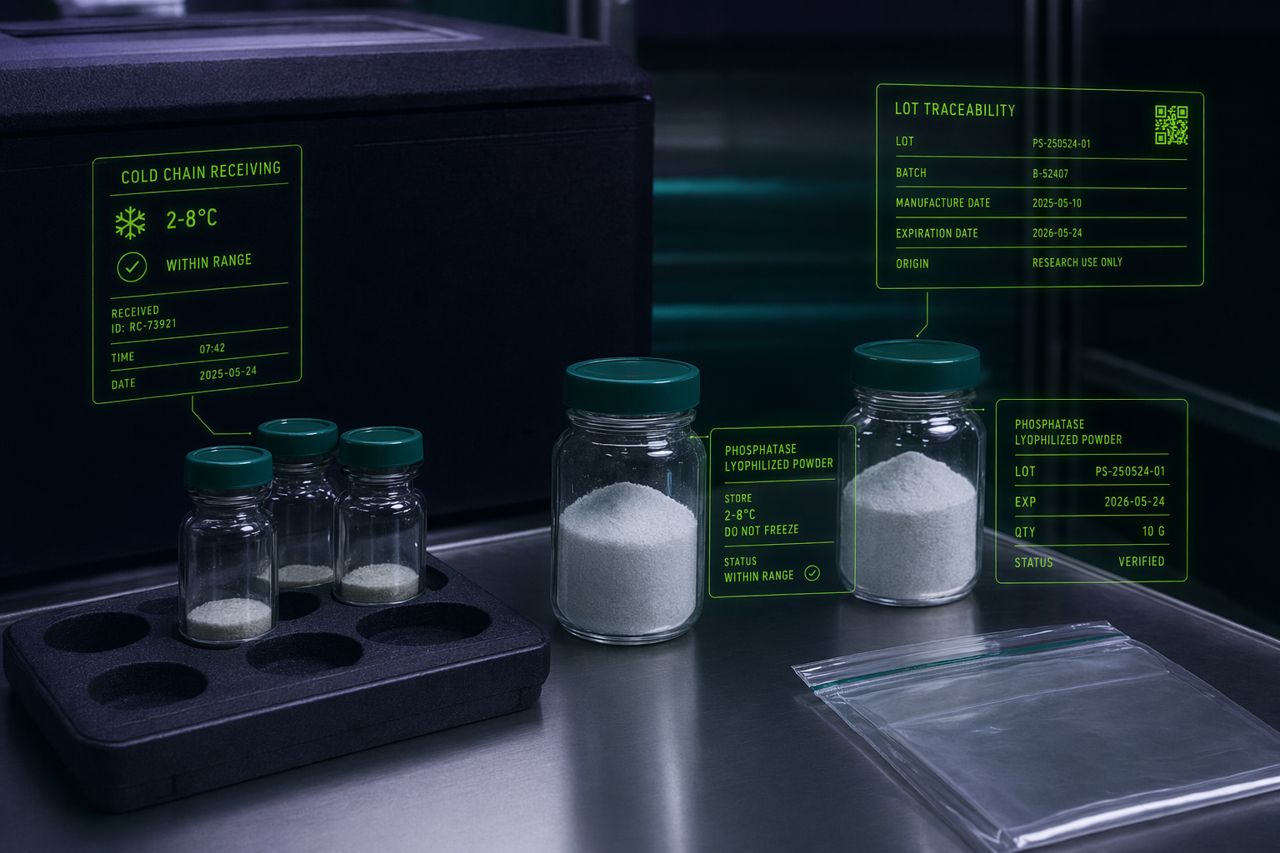
| Lyophilized or dry powder | Moisture control, desiccation, reconstitution behavior, dust management | Is reconstitution fast, complete, and compatible with the process buffer? |
| Immobilized phosphatase | Carrier stability, leaching, wash compatibility, reuse conditions | What cleaning and regeneration exposures will the enzyme see? |
| Premix or formulated blend | Excipient compatibility, ingredient interactions, shelf-life validation | Which component is the limiting stability factor? |
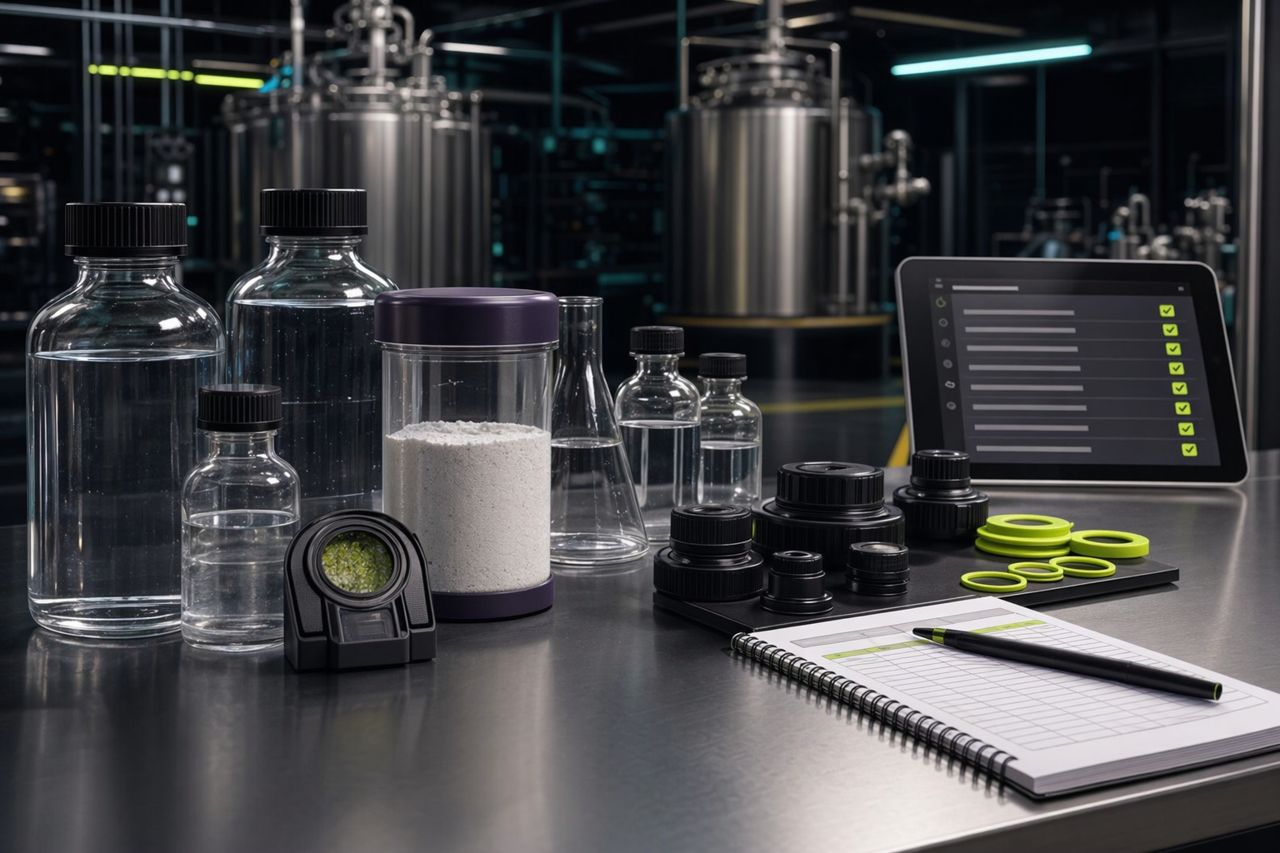
Use this checklist before requesting samples, approving a supplier, or transferring a phosphatase process from bench to plant.
Depending on enzyme class and application constraints, stabilizing systems may include sugars, polyols, salts, proteins, polymers, surfactants, antioxidants, or controlled ionic environments. The correct choice depends on the phosphatase, the dosage format, and the downstream tolerance for residual materials.
For regulated or label-sensitive applications, excipients should be selected with both enzyme stability and customer documentation in mind.
Preservatives can protect liquid formulations from microbial growth, but they may be incompatible with certain enzyme classes, diagnostic readouts, food applications, or biological systems. Preservative selection should be application-led, not copied from an unrelated enzyme product.
The container is part of the formulation. Glass, high-density polymers, liners, stoppers, seals, and dispensing hardware can influence adsorption, leachables, oxygen ingress, moisture uptake, and sample recovery.
For high-value diagnostic or biotechnology workflows, container compatibility should be evaluated before commercial packaging is locked.
A practical phosphatase supply plan should include more than a label condition. Request or develop documentation that addresses:
For industrial scale, also define what happens when an excursion occurs. A temperature event, delayed delivery, or broken cold-chain record should trigger a documented disposition pathway rather than an improvised decision on the production floor.
Diagnostic workflows often require stable signal behavior, low background interference, clean lot-to-lot comparability, and predictable performance after storage. Phosphatases used in reagent systems should be reviewed for preservative compatibility, surface adsorption, freeze-thaw behavior, and matrix-specific inhibition.
Food-related phosphatase use may involve complex raw materials, variable mineral content, natural inhibitors, and sanitation constraints. The handling plan should account for ingredient variability, process hold times, and any label or compliance requirements tied to the enzyme preparation.
Biotech and fermentation-adjacent applications can expose phosphatases to salts, biomass residues, proteases, organic compounds, and changing pH. Stability should be evaluated under realistic process conditions, including upstream impurities and downstream separation requirements.
When phosphatase is part of a blend, instability may come from ingredient interaction rather than the enzyme alone. Review sequence of addition, concentrate compatibility, water quality, microbial control, and whether other components alter pH or ionic balance over time.
Investigate the handling chain if you observe:
These signs do not always mean the phosphatase is unsuitable. They often indicate that storage format, buffer, container, mixing, or use-window assumptions need to be redesigned.
To obtain a useful quote and technical fit recommendation, prepare the following details:
If you are evaluating phosphatase for a defined formulation, diagnostic system, food process, or industrial biotech workflow, share your operating window and procurement requirements. Phosveil will help frame the technical fit before commercial discussion.
Phosphatase stability is controlled by the full operating context: enzyme class, matrix, buffer, temperature exposure, container, shipping chain, and user handling. Treat storage as part of the process design, not a label footnote.
Tell us your application and volume — we reply with pricing and lead time.